Showing posts with label Book. Show all posts

Friday, December 27, 2013

Lancelot, the lovely lion


Lancelot is a charming baby lion who is unhappy, as he can't roar and purr. He lives in the zoo of Mr. Zipp. It's a lovely tale by Marjorie Barrows. But the most attractive part of this pocket size squarish book is its illustrations by Jean Tamburine.
Some of the illustrations are in two color whereas the others are in multi color. This book seems to be of circa 1963. It has a simple story where lion cub gets its first roar in an emergency in the zoo. All the animals in the zoo live happily and play with one another. Fusby, the mouse and Lancelot are friends. Lancelot once, while playing with a bone tosses it to fall it into kangaroo's pocket which he refuses to return saying, 'Finders Keepers!'
Fusby with a matchstick sets a fire and soon Lancelot's bed catches it.
It's then Lancelot makes its first roar to wake up Mr. Zipp who rushes to the spot and puts off the fire. He then takes out all the animals to have a picnic till the visitors begin to arrive. Pleased with Lancelot's gesture, Mr. Zipp put a pasteboard crown oh its head.
This is the story in brief.
But the illustrations are great, indeed.
This is the hero of the story. Lancelot.


The zoo of Mr. Zipp where all the animals live in a playful manner.


When there is fire in the zoo, Mr. Zipp rushes on the bicycle with a bucket of water on hearing the roar of Lancelot.


And this is the first ever roar of Lancelot.


Imagine a Lion cub putting on a polka dot bow on its tail. Lancelot is honored with a pasteboard crown.


This end cover is the most attractive part of the book. How colorful and indicative it is! The animals are shown with their babies. They play, they love! 


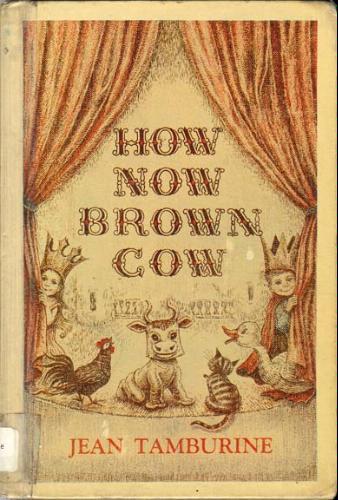
The curiosity to know regarding the other works of artist Jean Tamburine led to various illustrations made by her. 

MILKMAN BILL, Vintage Rand McNally Junior Elf Book, by Jessica Potter Broderick, illustrated by Jean Tamburine, 1960

And here is the artist herself. 
Jean Tamburine 


(Note: Last 3 images from net.) 

Thursday, December 26, 2013

Awesome animals


Just love those NBT (National Book Trust of India) and CBT (Children Book Trust) publications. Many of the children books have been prepared by eminent artists and each in a different manner. The emphasis has been given more to the pictorial part to educate the children in a true manner. However, most of these books are of pre-discovery channel era when many of the children were not knowing most wild animals.
Have a look upon this book 'Animal World' by Aurobindo Kundu. It's in 2 color printing with lovely prints of various animals, 12 to be specific.

The animals have been introduced in a single line with rhyming word. e.g.: The mighty LION Lord of the jungle, And the fleet-footed DEER Hears him rumble.


The one-horn RHINO walks with a thud


The friendly DONKEY Loves to bray.. 


And here is HIPPO! He's in water all day.


This is the cutest one. The brave WILD BOAR Is a fearless one..


How lovely this elephant is! It says, "But now the ELEPHANT Trumpets his mood.

Tuesday, December 10, 2013

The flea, the mouse, the spider and other illustrated stories


This is a German book originally titled 'Der Floh, Die Maus, Die Spinne und andere Bildgeschichten'. As per the Google translation, it is 'The flea, the mouse, the spider and other illustrated stories '. A lovely book with stunning illustrations! Not understanding a single word in German, the illustrations in the book were so striking that it became almost irresistible to get this book. No, no, the Google translation was not there at that time, nor was blogging. Yet this book became so close to heart that it remained almost handy.
Not knowing anything about the author-illustrator Wilhelm Busch before the Google era, the wikipedia has a detailed page on him.
Meanwhile see this simple, yet elegant illustrations on the front jacket.


 This story is titled 'Die Maus'. (The Mouse). Not a single word, just liiustrations, illustrations and illustrations. They seem to have done with ink, brush and some with pencils. Here the lines are thin, yet bold. Notice the rat in the foreground.


 The lines here start getting thicker, probably with the use of ink. The water color is also used here. See how the open umbrella is shown.


The rat slips into the cat and it is finally caught. Notice the thick strokes of black ink in the background as well as in the foreground. The chair also fall down while collecting the rat in the cap. The detail of fingers is not shown.


 The rat being caught is dropped in a drum and is covered. Watch the use of water color and pastel in the woman's top and in the umbrella. See how simply the three planes are shown with few strokes.


 Notice the fingers of the hand of the man in both the illustrations. The last picture is difficult to understand. Is the man holding a rat with his fingers? Why the woman is standing on the chair? What is she pouring from the bottle? Are they trying to drown the rat?


And the lines become thinner, finer, clearer in the last illustration! You can notice each and everything. The broken bottle, candle, bowl etc.. And how the drum behind the bed is shown with lighter strokes. 


This is the last jacket of the book. simple, yet elegant. 


And now something about the artist Wilhelm Busch courtesy wikipedia. 
Heinrich Christian Wilhelm Busch (15 April 1832 – 9 January 1908) was a German humorist, poet, illustrator and painter. He published comic illustrated cautionary tales from 1859, achieving his most notable works in the 1870s. Busch's illustrations used wood engraving, and later zincography.


Wilhelm busch.png
A self-portrait by Wilhelm Busch
Busch drew on contemporary parochial and city life, satirizing Catholicism, Philistinism, strict religious morality and bigotry. His comic text was colourful and entertaining, using onomatopoeianeologisms and other figures of speech, and led to some work being banned by the authorities.
Busch was influential in both poetry and illustration, and became a source for future generations of comic artists. The Katzenjammer Kids was inspired by Busch's Max and Moritz, one of a number of imitations produced in Germany and the United States. The Wilhelm Busch Prize and theWilhelm Busch Museum help maintain his legacy. His 175th anniversary in 2007 was celebrated throughout Germany. Busch remains one of the most influential poets and artists in Western Europe. 
More about the artist can be read here: 

Friday, November 29, 2013

Dracula: Eternally dead yet alive

Bram Stoker's Dracula has been a character we love to read more and more about him. After it was first published in 1897, various editions are being published in many countries. This one is an illustrated story of Count Dracula which published in 1976 and it was the sixth reprint. The story was adapted by Naunerle Farr and illustrations were by Nestor Redondo. 
Just feel the impact of Stoker's Dracula through the illustrations of Nestor. 

The cover page 
The characters 
The Count with the background 
Just see the perspectives of the illustrations 
The story moves ahead with chills and thrills 
It has some close-ups and mid-shots 
The light and shades effect 
Some interesting locations 
.....and the happy end.